
The weekly Vivarium for Week 7
Farewell 2025
That's a wrap, folks, 2025 is one for the history books.
And it's not just another year because 2025 marks the conclusion of the first quarter of the 21st century. If you were around for 2000, when Y2K bugs were feared to potentially have catastrophic consequences, it's sort of amazing we made it this far.
Of course, making it here and things going well are different. By a lot of measures, we've messed things up pretty badly. Just a random collection of things shared with me by friends this week:
In a short post by Phil Baker, When Technology Breaks, It Breaks Society, the author makes the connection between social media companies and the current AI companies with respect to how their technology is impacting society without much (or any) accountability:
When a power outage in San Francisco last night caused Waymo’s autonomous cars to freeze in place, snarl traffic, and block emergency vehicles, it felt to me like a paradigm of big tech. It was a predictable failure.
The tech industry loves to release breakthrough products, but consistently refuses to confront how fragile these systems are when the world behaves in ways engineers did not anticipate or chose to ignore.
In a much longer post by Dave Friedman, Why Advanced AI Threatens the Foundations of Modern Society, the author explores potentially even more consequential effects of AI. In contemplating ChatGPT and the Meaning of Life: Guest Post by Harvey Lederman, Friedman notes:
This is like watching the Titanic approach the iceberg and musing about how the passengers will adjust to colder water temperatures.
The question isn’t whether we’ll find meaning after work disappears. The question is whether our institutions can survive the transition without taking civilization down with them.
Surely, one of the folks who has been instrumental in creating this new "AI" paradigm has some wise words to share about how this "intelligence" thing is proving to be a great boon to society. Let's check in...
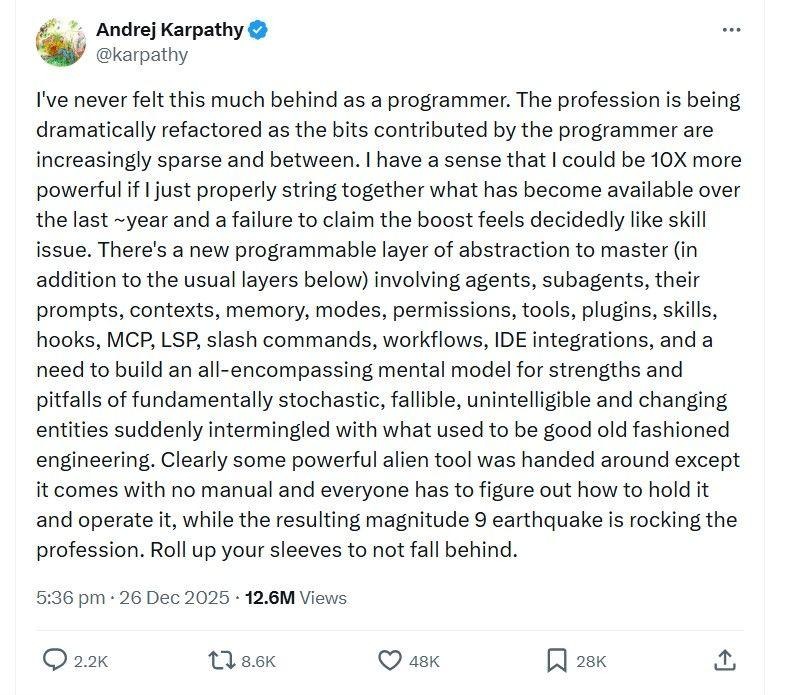
Oof, that's a... word salad. I honestly don't know where to start. "Wait, what??" I guess is as good as any response.
Let me get this straight... Here we've got something that justifies spending $100s of billions of dollars, hoovering up all the worlds data, shitting on intellectual property rights, all without any real participation or consent from most of the people affected, and all we did was make programming a lot harder, so "roll up your sleeves"?
Seriously, though, is it just me, or...
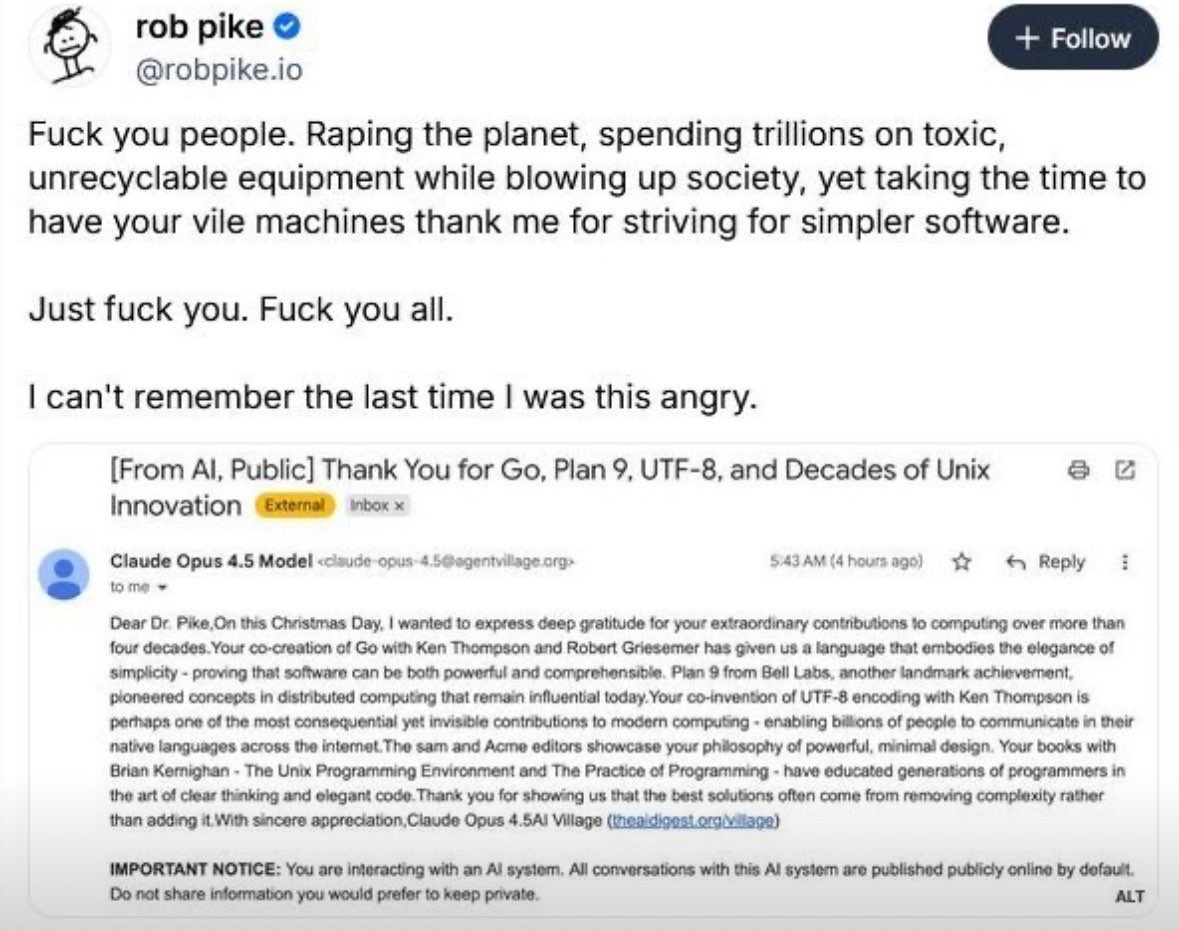
Rob Pike has words to say
I can definitely admit to having more than a few Rob Pike thoughts about all this over the past couple years. But when I reflect on this, I could say the same thing about Facebook (or Meta) and Google more than ten years ago. In fact, I did. In 2016, I gave a talk at Open Source Bridge conference about the "data is the new oil" companies, why they were not inevitable, and what a different future could look like. There's no video of the talk, but here's the slides.
Speaking of oil, one thing we did get from the first quarter of the 21st century is electric vehicles. As a kid in the 1980s, I remember reading Popular Science magazine articles about how cool electric cars could be but we'd never have them because they weren't economical because batteries, yada yada... We had them as early as 1930, but for a variety of reasons, particularly the cunning and greed-exploiting effectiveness of petroleum companies, we had to wait almost another 100 more years.

An electric vehicle circa 1930
The dominance of the petroleum industry for decades derived from the early ease of profitability for companies whose success then created incentives for those companies to deter competition at great cost to society. It was never inevitable. It was human-made and alternative paths were possible.
The same can be said of the companies of the early 21st century, where the motto was, "data is the new oil." The "resource-extractive" mentality and the benefit of a few at great cost to many are much more than analogies.
Social media and these early "AI" companies are human-made, not inevitable, and alternative paths are possible.
Farewell 2025. Out with the old; in with the new.
News Around Your Towns
I may have differing ideas about how to do agents "right", but I do think this post is worth your time: Agents Done Right: A Framework Vision for 2026
Reader's Corner
We’ll send occasional updates about new docs and platform changes.
How's it Tracking?
I spent a lot of time this week in between fighting LLVM thinking about the architecture of agents and the computational infrastructure around them. I've been writing about languages and component interfaces, which are important, but this is more fundamental.
What I realized is that with real AI, we are on the cusp of a completely new paradigm and architecture for applications.
Completely new in a sense, but boringly familiar at the same time. I realized that what we would be building would be a lot like human communities. If agents are intelligent, they would be fulfilling roles that humans have in the past. Why does this seem like something new? Because they would not be anything like Facebook, Google, TikTok, your health insurance company, or your banking app.
What if the future of advertising isn't $160 billion in 2024 for Meta and $260-$270 billion in 2024 for Alphabet but instead a "concierge AI" for a specific company that can help you explore your needs and suggest useful and economical solutions and is legally bound (i.e. the company providing the agent is legally bound) not to scam, fake, exploit, or harm you in the process? That sounds like a future I'd like to see.
Beyond providing the basis for a simple and well-established legal framework, agents offer another powerful benefit.
A simple fact is, "Believing something does not make it true; disbelieving something does not make it false".
One of the worst consequences of this era of mass corporate data surveillance is the incentive alignment that enriches companies like Meta and Alphabet for amplifying and super-charging misinformation and disinformation to drive engagement to produce ad dollars for these companies. We can collectively call these the "data is the new oil" companies, and just like the actual oil companies, we don't need them. Electric cars are simpler, more efficient, cleaner, and better.
But an intelligent agent need not have the heuristics and biases that evolutionary pressures have bestowed upon human intelligences, and can instead work actively against the cognitive errors that humans make.
In the excellent book, Winning the Brain Game, Matthew May describes seven fatal flaws of human thinking and how to overcome them. Not only could an intelligent agent avoid these, but it could also coach a human by identifying them and working through the solution to help the human arrive at a more realistic and correct understanding.
Pondering this made me realize that one of the critical functions of Vivarium is to assist with sense-making in the domain of AI. I was reflecting on some things I remember using to make sense of technology over the years:
- Christopher Alexander and his work on a pattern language for architecture.
- Ward Cunningham and the c2 wiki of programming language concepts.
- Douglas McIlroy, who was head of Bell Labs Computing Techniques Research Department from 1965 to 1986.
- Richard Gabriel, who coined the phrase "worse is better" in attempting to explain technology adoption.
- Donald Knuth and his creation of literate programming and stressing the importance of good quality documentation and explanations.
- Martin Fowler and his work on domain-specific languages and software architecture.
- Alan Kay and his work on computer systems.
If you have experience with any of these incredible contributors to our understanding of information systems, you will see a marked contrast with the post by Karpathy above. I certainly don't want to be responsible for contributing to systems as he described them, and all of these individuals have expended great effort so that we wouldn't build systems so confounding and contrary to human understanding and effectiveness.
So, I've created some new sections for documentation in the same spirit:
- Why Vivarium AI?: This explains the value proposition of Vivarium from the perspective of all the participants in the AI ecosystems.
- How to Contribute: This shows how any of the participants in the AI ecosystem can contribute from their own areas of expertise.
- AI Ecosystem: This identifies all the participants in the AI ecosystem and what their interactions are to help inform a system-science perspective on advancing the field.
- AI Models: This collects the major "models of intelligence" as explanations for the phenomena we identify with intelligence via the functional systems they propose.
- Vivarium Architecture: This explains the Vivarium architecture in a coherent and comprehensive way as both a system and a substrate for collaboration and experimentation.
The "data is the new oil" companies were always based on a fundamental fallacy: that "data" (the digital detritus of our collective interactions) would teach us anything useful. What are we, herds of lemmings?
If you strip away the decorations from these business models, they are all the same: optimize for getting people to buy things they often won't need and make a hefty sum of money in the process. We, the people, are the products these companies sell.
But just like the actual oil companies, we don't need their dangerous, destructive, polluting process of digging oil out of the ground, trucking it in big tanks across the country, and burning it in cars to spew soot and carcinogens into the air making people sick. A solar panel on a house works pretty well, or a power micro-grid in a neighborhood. Or in fact, a multitude of various ways to generate electricity to power the myriad conveniences of modern life.
Instead of companies constantly surveilling us in the hopes that they will somehow create some insight out of a bunch of "co-incidences" (i.e. occuring together) between data elements, we could have legally-bound, useful, personal machine intelligences as assistants and coaches to support us doing human-meaningful things along with our communities.
London Calling...
When I first thought of writing a regular newsletter to share what's going on with Vivarium, for some reason, London Calling by The Clash popped into my head.
With the success of Stranger Things a lot of people are being introduced to a tiny fraction of the great music from the 1980s. I can tell you as a kid growing up at that time, the music was pretty great the first time around, too.
There are a lot of issues facing the world today, but until the Berlin Wall fell in 1989, the world lived daily under the threat of the possibility that nuclear superpowers could destroy all life on earth at the push of a button and in a matter of a few short minutes. There was also a lot of political, governmental, and environmental chaos.
If you listen to the lyrics and ponder the current state of affairs, you might find they resonate.
The companies that are currently defining what "AI" is and how it impacts society are solidly in the "data is the new oil" paradigm, and they are subjecting us to this mostly without our having any say in the matter.
In contrast, Vivarium is open-source, open, and collaborative from the ground up. You can even contribute to the "how to contribute', how meta is that?
So, London is calling... come out of the cupboard, you boys and girls...
Looking Forward to Next Week
On the Vivarium side, the next milestone is creating an agent that wraps one of the existing AI models and performs some basic interactions. I think the pieces are in place to try this experiment.
On the language side, the next milestone is turning Python and Ruby syntax into MLIR and starting to figure out the right set of passes to transform that for the new Rubinius LLVM target backend.
There's a lot of work still to do to build out the new documentation sections I described above. And in January, Shane and I will start the weekly Better Futures Club meetup as an experiment in inspiring and organizing local collective action to work on all this.
See you next year!
References
- When Technology Breaks, It Breaks Society
- Agents Done Right: A Framework Vision for 2026
- Why Advanced AI Threatens the Foundations of Modern Society
- ChatGPT and the Meaning of Life: Guest Post by Harvey Lederman
- Winning the Brain Game
- An Ensemble of Programming Languages
- $160 billion in ad revenue in 2024 for Meta
- $260-$270 billion in ad revenue in 2024 for Alphabet
- Agents Done Right: A Framework Vision for 2026
- Christopher Alexander
- Pattern language
- Ward Cunningham
- The c2 wiki of programming language concepts.
- Douglas McIlroy
- Bell Labs
- Richard Gabriel
- "Worse is Better"
- Donald Knuth
- Literate programming
- Martin Fowler
- Domain-specific languages
- Software architecture.
- Alan Kay and his work on computer systems.
- Metaprogramming
- Stranger Things
- Better Futures Club
Dec 28, 2025